Parallel Scenarios: A New Paradigm and Evolution Path for Scenario-Based Applications of Artificial Intelligence
DOI:
https://doi.org/10.61702/35x9bm85Keywords:
parallel scenarios, scenario engineering, ACP methodAbstract
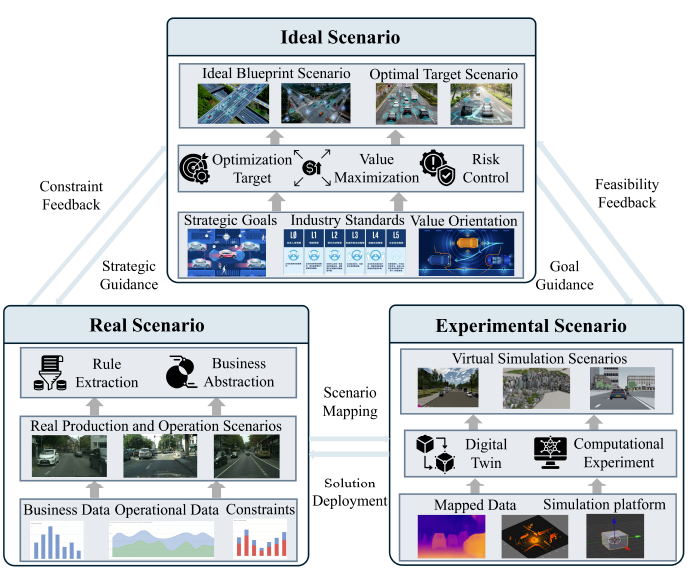
Scenario engineering has emerged as a promising approach for deploying artificial intelligence in manufacturing, transportation, healthcare, and other real-world domains. However, its current development still faces several structural limitations, including an overemphasis on models rather than scenarios, on access rather than restructuring, and on capability rather than governance. To address these challenges, this paper proposes a new paradigm of parallel scenarios grounded in the framework of parallel intelligence, namely Artificial Societies, Computational Experiments, and Parallel Execution (ACP). In this paradigm, a parallel scenario is defined as an intelligent application system composed of real scenarios, experimental scenarios, and ideal scenarios. The real scenario represents the physical operational environment, the experimental scenario provides a controllable space for simulation, deduction, and optimization, and the ideal scenario serves as the value-oriented target for system evolution. Through the ACP operating mechanism, these three types of scenarios are dynamically connected through continuous interaction, parallel operation, and iterative tuning, thereby forming a closed-loop mechanism for scenario evolution and intelligent decision-making. On this basis, the paper further develops an operational paradigm driven by parallel scenarios, including scenario sensing, plan simulation, implementation, and feedback iteration, and clarifies the functional role of AI agents in cross-scenario coordination. In addition, model context protocol, the agent-to-agent collaboration protocol, and the ACP communication protocol are introduced to support autonomous collaboration among agents across the three scenario types. This study provides both a theoretical foundation and a practical framework for advancing scenario engineering from isolated technical deployment toward systematic value creation and intelligent governance.
Downloads
Downloads
Published
Issue
Section
Categories
License

This work is licensed under a Creative Commons Attribution 4.0 International License.
Authors retain copyright to their published work and retain full publishing rights without restriction. Articles are published under the Creative Commons Attribution 4.0 International License (CC BY 4.0), which permits sharing and adaptation for any lawful purpose provided that appropriate credit is given to the authors and the original publication is cited.
Authors grant JCPSI and the Association of Global Intelligent Science and Technology (AGIST) a non-exclusive right of first publication and the right to identify JCPSI as the original publisher of record.
Authors may deposit and make publicly available the submitted version, accepted manuscript, and published version of record in an institutional repository, disciplinary repository, funder repository, personal website, or other repository of their choice without embargo, provided that the published article is cited and the journal version of record is linked when available.
How to Cite