CGAN-DA: A Cross-Modality Domain Adaptation Model for Hand-Vein Biometric-based Authentication
DOI:
https://doi.org/10.61702/YRMC5182Keywords:
Palm-vein Authentication, Domain Adaptation, Generative adversarial network, Convolutional Neural NetworkAbstract
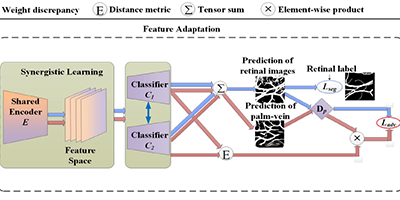
Palm-vein recognition has been the focus of large research efforts over the last years. However, despite the effectiveness of deep learning models, in particular Convolutional Neural Networks (CNNs), in automatically learning robust feature representations, thereby obtaining good accuracy, such good performance is usually obtained at the expense of annotating a large training dataset. Labeling vein images, however, is an expensive and tedious process. Although handcrafted schemes for data augmentation usually increase slightly performance, they are unable to cover complex variations inherently characterizing such images. To overcome this issue, we propose a new unsupervised domain adaptation model, called CycleGAN-based domain adaptation (CGAN-DA), that extracts discriminant representation from the palmvein images, without requiring any image labeling. Our CGAN-DA models allows a conjoint adaptation, at the image and feature levels. Specifically, in order to enhance the extracted features’ domain-invariance, image appearance is transformed across two domains, palm-vein domain and retinal domain. We employ several adversarial losses namely a segmentation loss and a cycle consistence loss to train our model without any annotation from the target domain (palm-vein images). Our experiments on the public CASIA palm-vein dataset demonstrates that our models significantly outperforms the s tart of the art in terms of verification accuracy.
Downloads
Downloads
Published
Issue
Section
License

This work is licensed under a Creative Commons Attribution 4.0 International License.
Authors retain copyright to their published work and retain full publishing rights without restriction. Articles are published under the Creative Commons Attribution 4.0 International License (CC BY 4.0), which permits sharing and adaptation for any lawful purpose provided that appropriate credit is given to the authors and the original publication is cited.
Authors grant JCPSI and the Association of Global Intelligent Science and Technology (AGIST) a non-exclusive right of first publication and the right to identify JCPSI as the original publisher of record.
Authors may deposit and make publicly available the submitted version, accepted manuscript, and published version of record in an institutional repository, disciplinary repository, funder repository, personal website, or other repository of their choice without embargo, provided that the published article is cited and the journal version of record is linked when available.
How to Cite