Integrating Cyber-Physical-Social Intelligence for Safer and Smarter Transportation Systems: A Comprehensive Literature Review

Authors

DOI:

https://doi.org/10.61702/nbvhvg67

Keywords:

Cyber-Physical-Social Intelligence, Transportation Safety, Human-Centered Systems, Intelligent Infrastructure, Connected Vehicles

Abstract

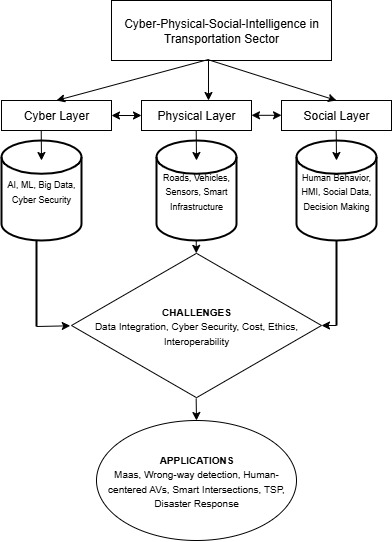
The number of fatalities due to human error or mistakes has increased all around the world, including the United States, over the past decades. According to NHTSA, over 42,000 deaths have been recorded all over the United States in 2022, and 90% of which was due to human error or mistakes. Although there was a significant advancement in transportation technologies, the number of crashes has not decreased over the years. The need for integrating new emerging technologies with the physical and social layers is necessary to consider, as human feedback and interaction over the technologies can reduce crashes and improve mobility. Studies show that Cyber-Physical-Social-Intelligent technologies like Vehicle-to-Everything (V2X) communication can reduce traffic fatalities by up to 80%, while human-centered design in automation can significantly improve compliance and lower risky behaviors. Despite their growing importance, there is a lack of proper review to integrate these machine-based autonomous technologies with human feedback input, along with the implementation challenges. This paper provides a comprehensive literature review of CPSI applications in transportation sectors, exploring theoretical models, the potential scopes, and the immense possibilities of integration of CPS-based technologies in the current transportation system in a simple, easy, and fluent way. Real-world applications of these technologies have also been discussed for the smart city framework, wrong-way driving detection, human-machine interaction, and other aspects, along with their potential benefits. Despite these advancements, several technical and institutional challenges, like data security, data management, computational capability, and financial restraints, can impede the widespread deployment of CPSS. By addressing these challenges, this review presents the key gaps in the implementation challenges of CPSI and proposes a roadmap for future development. This research will create scope for future researchers to study this growing field as well as support policymakers, engineers, and researchers in planning and designing transportation systems that are not only intelligent but also adaptive, human-centered, inclusive, and safer for all users, contributing to long-term sustainable goals like vision zero initiatives.


Downloads
Download data is not yet available.

Author Biographies

  • MD. Sadman Islam, Rowan University

    Md Sadman Islam was born in Dinajpur, Bangladesh, in February 1998. He received the B.Sc. degree in civil engineering with a major in transportation engineering from Bangladesh University of Engineering and Technology (BUET), Dhaka, Bangladesh, in 2022. He is currently pursuing the Ph.D. degree in civil engineering at Rowan University, Glassboro, NJ, USA, with a focus on transportation safety.

    He worked as a Project Executive at Dom Inno Real Estate Development and later served as a Lecturer at the Bangladesh Army University of Science and Technology. He is currently a Graduate Research Fellow and Graduate Teaching Fellow at Rowan University. His work includes multiple state-funded research projects on school bus safety, pavement marking evaluation, transit accessibility, and wrong-way driving detection systems. He has presented at the Transportation Research Board (TRB) Annual Meeting and published studies on heavy vehicle crash analysis and machine learning applications in transportation. His research interests include heavy vehicle safety, Intelligent Transportation Systems (ITS), data-driven crash analysis, and smart mobility solutions.

    Mr. Islam is a Student Member of the Institute of Transportation Engineers (ITE), the Intelligent Transportation Society of New Jersey (ITSNJ), and the American Society of Civil Engineers (ASCE). He received the ITSNJ 2024 Outstanding Graduate Student Award, Rowan CEE 2025 Outstanding Graduate Student Award, and the 2023 Rowan Graduate Student Travel Competition Award. He also serves as President of the Rowan University ITE Student Chapter and Vice President of the Rowan Bangladesh Student Association.

  • Ahmed Imtiaz Zamee, Rowan University

    Ahmed Imtiaz Zamee was born in Kazla Village, Rajshahi, Bangladesh in 1999. He received the B.Sc. degree in civil engineering from the Bangladesh University of Engineering and Technology (BUET), Dhaka, Bangladesh, in 2022. He is currently pursuing a Ph.D. degree in civil engineering at Rowan University, Glassboro, NJ, USA, with a focus on public transportation.

     He worked as an Assistant Engineer in the Tendering and Planning Department of Sinamm Engineering Limited, Dhaka, Bangladesh. He is currently working as a research fellow at Rowan University. His work includes several state-funded research projects such as wrong-way driving detection technologies, school bus safety, and identifying travel needs. His research interests include public transportation, Intelligent Transportation Systems (ITS), spatial analysis of data, and smart mobility solutions.

    Mr. Zamee is a Student Member of the Institute of Transportation Engineers (ITE), the Intelligent Transportation Society of New Jersey (ITSNJ), and the American Society of Civil Engineers (ASCE).

  • Mohammad Jalayer, Rowan University

    Mohammad Jalayer was born in Iran. He received the B.Sc. degree in civil engineering from the University of Mashhad, Iran, in 2007, the M.Sc. degree in transportation engineering and planning from Sharif University of Technology, Tehran, Iran, in 2010, and the Ph.D. degree in civil engineering with a focus on transportation engineering from Auburn University, Auburn, AL, USA, in 2016. His major field of study is transportation safety and intelligent transportation systems.

    He has worked in both academia and industry, including positions as Project Manager and System Analyst in Iran, Research Associate at Rutgers University, and Research/Teaching Assistant at Southern Illinois University and Auburn University. Since 2018, he has served as a faculty member in the Department of Civil and Environmental Engineering at Rowan University, where he is currently an Professor. His professional work includes principal investigator roles in more than 30 research projects funded by agencies such as NJDOT, NJ TRANSIT, USDOT, and NHTSA. His research has resulted in numerous journal articles, conference papers, and technical reports, primarily focusing on highway safety, crash modeling, ITS, connected and autonomous vehicles, and traffic operations.

    Dr. Jalayer is a member of several professional organizations, including ASCE, ITE, TRB, ATSSA, and ATSIP. He serves on national review panels for NCHRP and TCRP projects and holds editorial board positions for journals such as the Journal of Transport Safety, Journal of Safety Studies, and Journal of Sustainable Development of Transport and Logistics. He has received multiple awards, including the 2016 National HSIS Research Paper Award, the ASCE Young Civil Engineer of the Year (2017), and Rowan University’s Innovations in Teaching Award (2019).

GA

Downloads

Published

2025-12-30

Issue

Section

Journal of Cyber-Physical-Social Intelligence 2025

Categories

How to Cite

Islam, M. S., Zamee, A. I., & Jalayer, M. . (2025). Integrating Cyber-Physical-Social Intelligence for Safer and Smarter Transportation Systems: A Comprehensive Literature Review. Journal of Cyber-Physical-Social Intelligence, 4(1), 19. https://doi.org/10.61702/nbvhvg67

Similar Articles

1-10 of 13

You may also start an advanced similarity search for this article.