Simulation and calculation of wide frequency harmonic temperature rise based on dry type hollow reactor
DOI:
https://doi.org/10.61702/ssv9g590Keywords:
Dry type hollow reactor, harmonics, Coil Loss, Temperature rise calculation.Abstract
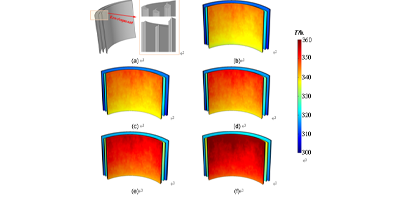
With the increasing size of the grid, a large number of non-linear equipment applicable, harmonic pollution is becoming more and more serious. Higher demands on the harmonic operation capability of reactor filtering equipment. In this paper, the dry type hollow reactor was taken as a research object, according to the field-circuit coupling principle, the establishment of finite element two-dimensional wire-turn unit electromagnetic simulation calculation model, solved the coil frequency current superimposed on different harmonic current frequency, content curve. Then calculate the winding loss of each layer, carry out the fluid-heat coupling simulation calculation, and get the temperature rise distribution of the reactor. Study shows that:Elevated harmonic content causes an increase in coil current amplitude and excitation of a stronger magnetic field, resulting in an increase in resistance loss and eddy current loss, leading to a rise in reactor temperature. The increase in harmonic frequency marginalizes the reactor coil current density distribution, increases the coil resistance, and leads to an increase in the local magnetic induction strength, resulting in an increase in coil eddy current losses, leading to an increase in reactor temperature.
Downloads
Downloads
Published
Issue
Section
Categories
License

This work is licensed under a Creative Commons Attribution 4.0 International License.
Authors retain copyright to their published work and retain full publishing rights without restriction. Articles are published under the Creative Commons Attribution 4.0 International License (CC BY 4.0), which permits sharing and adaptation for any lawful purpose provided that appropriate credit is given to the authors and the original publication is cited.
Authors grant JCPSI and the Association of Global Intelligent Science and Technology (AGIST) a non-exclusive right of first publication and the right to identify JCPSI as the original publisher of record.
Authors may deposit and make publicly available the submitted version, accepted manuscript, and published version of record in an institutional repository, disciplinary repository, funder repository, personal website, or other repository of their choice without embargo, provided that the published article is cited and the journal version of record is linked when available.
How to Cite