Small-Large Model Collaboration in Public Opinion Topic Discovery A Case Study with the Pager Bomb Attack

Authors

  • Baoyu Zhang China university of petroleum East China Author
  • Tao Chen China University of Petroleum East China Author
  • Weishan Zhang China University of Petroleum East China Author
  • Tao Wang National University of Defense Technology image/svg+xml Author
  • Qinghua Ni Macau University of Science and Technology image/svg+xml Author
  • Fei Lin Macau University of Science and Technology image/svg+xml Author
  • Linyuan Lv University of Science and Technology of China image/svg+xml Author
  • Juanjuan Li Chinese Academy of Sciences image/svg+xml Author
  • Fei-Yue Wang Chinese Academy of Sciences image/svg+xml Author

DOI:

https://doi.org/10.61702/w0azz083

Keywords:

public opinion, pager bomb, large and small model collaboration, DAO

Abstract

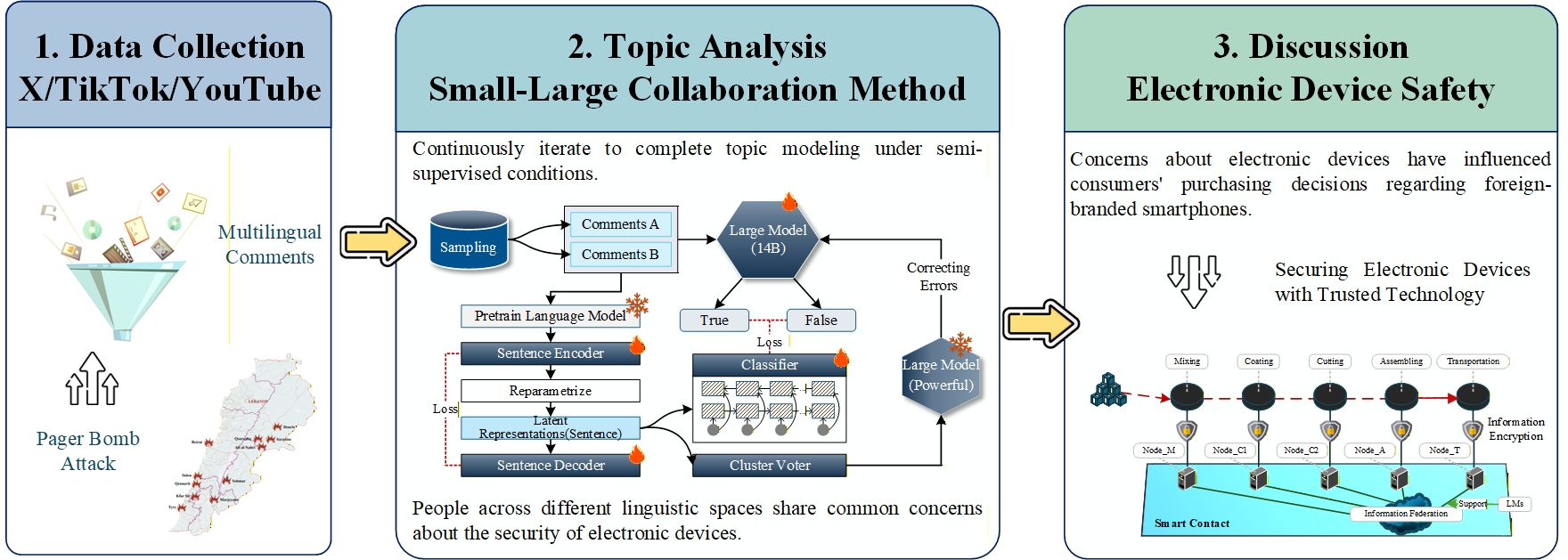
In September 2024, Lebanon was rocked by an unprecedented cyber-physical attack using Pager bombs. The attack combined advanced cyber warfare techniques with physical destruction, resulting in significant loss of life, infrastructure damage, and geopolitical repercussions. In this paper, we analyze the attitudes on this attack, from both English and Arabic social media users, and investigate impacts on global electronic devices sales and usage. A new topic discovery approach using large models and small models collaboration is proposed. We compare English and Arabic topics generated on social media and find that people in different language spaces share common topics of anxiety on this event. By analyzing market share trends in both China and the United States, an obvious correlation can be found between this event and phone sales. In addition, we discuss the evolution of warfare, and how DAOs(Decentralized Autonomous Organizations) can be utilized to improve the security of electronic devices by secured monitoring of their whole lifecycle.

Downloads
Download data is not yet available.

Author Biographies

  • Tao Chen, China University of Petroleum East China

    Tao Chen is currently pursuing the Ph.D. degree in computer science with the Big Data Intelligent Processing Team, and the College of Computer Science and Technology at China University of Petroleum, China. His main research areas are data mining, social computing.

  • Weishan Zhang, China University of Petroleum East China

    Weishan Zhang Member,IEEE received the PhD degree from Northwestern Polytechnical University, China in 2001. He is currently a full professor and the deputy head for research at the College of Computer Science and Technology, China University of Petroleum. He has published more than 100 papers. His current H-index according to Google scholar is 25. His current research interests are big data mining, social computing, and artificial intelligence.

  • Tao Wang, National University of Defense Technology

    Tao Wang received the Ph.D. degree in social computing from the National University of Defense Technology, Changsha, China, in 2015. Currently, he is an Associate Professor with the College of Systems Engineering, National University of Defense Technology. His research interests include social computing and human resource analytics.

  • Qinghua Ni, Macau University of Science and Technology

    Qinghua Ni is currently pursuing a Ph.D. degree at the Department of Engineering Science, Faculty of Innovation Engineering, Macau University of Science and Technology,Macau, China. Her research interests include parallel intelligence, blockchain and DAO, and social computing.

  • Fei Lin, Macau University of Science and Technology

    Fei Lin is currently pursuing a Ph.D. degree at the Department of Engineering
    Science, Faculty of Innovation Engineering, Macau University of Science and
    Technology,Macau, China. His research interests include parallel intelligence,
    Large Language Model (LLM), and Embodied Agent.

  • Linyuan Lv, University of Science and Technology of China

    Linyuan L¨u received her Ph.D. in statistical physics from the University of Fribourg and presently holds the position of professor in the School of Cyber Science and Technology at the University of Science and Technology of China. Her research interests include complex networks and social computing.

  • Juanjuan Li, Chinese Academy of Sciences

    Juanjuan Li Member,IEEE received her master degree in economics from Renmin University of China and Ph. D. degree in control science and engineering from Beijing Institute of Technology, Beijing, China. She is currently an associate professor with the State Key Laboratory of Multimodal Artificial Intelligence Systems, Institute of Automation, Chinese Academy of Sciences, Beijing, China. Her research interests include blockchain, DAO and decision intelligence.

  • Fei-Yue Wang, Chinese Academy of Sciences

    Fei-Yue Wang Fellow,IEEE received the Ph.D. degree in computer and systems engineering from the Rensselaer Polytechnic Institute, Troy, NY, USA, in 1990. He joined The University of Arizona, Tucson, AZ, USA, in 1990, where he became a Professor and the Director of the Robotics and Automation Laboratory and the Program in Advanced Research for Complex Systems. In 1999, he founded the Intelligent Control and Systems Engineering Center, Institute of Automation, Chinese Academy of Sciences (CAS), Beijing, China, under the support of the Outstanding Chinese Talents Program from the State Planning Council, and in 2002, he was appointed the Director of the Key Laboratory of Complex Systems and Intelligence Science, CAS, and the Vice President of the Institute of Automation, CAS in 2006. He found CAS Center for Social Computing and Parallel Management in 2008, and became the State Specially Appointed Expert and the Founding Director of the State Key Laboratory for Management and Control of Complex Systems in 2011. He is a Distinguished Professor with the Macau University of Science and Technology, Macau, China. His current research focuses on methods and applications for parallel intelligence, social computing, and knowledge automation. Dr. Wang received the National Prize in Natural Sciences of China, numerous best papers awards from the IEEE TRANSACTIONS in 2007, and became an Outstanding Scientist of the Association for Computing Machinery (ACM) for his work in intelligent control and social computing. He received the IEEE INTELLIGENT TRANSPORTATION SYSTEMS (ITS) Outstanding Application and Research Awards in 2009, 2011, and 2015, respectively, the IEEE Systems, Man, and Cybernetics Society (SMC) Norbert Wiener Award in 2014, and became the International Federation of Automatic Control (IFAC) Pavel J. Nowacki Distinguished Lecturer in 2021. Since 1997, he has been serving as the General or Program Chair of over 30 IEEE, Institute for Operations Research and the Management Sciences, IFAC, ACM, and American Society of Mechanical Engineers (ASME) conferences. He was the President of the IEEE ITS Society from 2005 to 2007, the IEEE Council of Radio Frequency Identification from 2019 to 2021, the Chinese Association for Science and Technology, USA, in 2005, the American Zhu Kezhen Education Foundation from 2007 to 2008, the Vice President of the ACM China Council from 2010 to 2011, the Vice President and the Secretary General of the Chinese Association of Automation (CAA) from 2008 to 2018, and the Vice President of the IEEE SMC from 2019 to 2021. He was the Founding Editor-in-Chief (EiC) of the International Journal of Intelligent Control and Systems from 1995 to 2000, IEEE Intelligent Transportation Systems Magazine from 2006 to 2007, IEEE/CAA JOURNAL OF AUTOMATICA SINICA from 2014 to 2017, China’s Journal of Command and Control from 2015 to 2021, and China’s Journal of Intelligent Science and Technology from 2019 to 2021. He was the EiC of IEEE INTELLIGENT SYSTEMS from 2009 to 2012, IEEE TRANSACTIONS ON INTELLIGENT TRANSPORTATION SYSTEMS from 2009 to 2016, and IEEE TRANSACTIONS ON COMPUTATIONAL SOCIAL SYSTEMS from 2017 to 2020. He is currently the President of the CAA’s Supervision Council and the EiC of the IEEE TRANSACTIONS ON INTELLIGENT VEHICLES. He is a Fellow of the International Council on Systems Engineering, IFAC, ASME, and the American Association for the Advancement of Science.

GA

Downloads

Published

2025-12-30

Issue

Section

Journal of Cyber-Physical-Social Intelligence 2025

Categories

How to Cite

Zhang, B., Chen, T., Zhang, W., Wang, T., Ni, Q., Lin, F., Lv, L., Li, J., & Wang, F.-Y. (2025). Small-Large Model Collaboration in Public Opinion Topic Discovery A Case Study with the Pager Bomb Attack. Journal of Cyber-Physical-Social Intelligence, 4(1), 15. https://doi.org/10.61702/w0azz083

Similar Articles

1-10 of 18

You may also start an advanced similarity search for this article.

Most read articles by the same author(s)